Pro-Life Conference for Mothers in Need
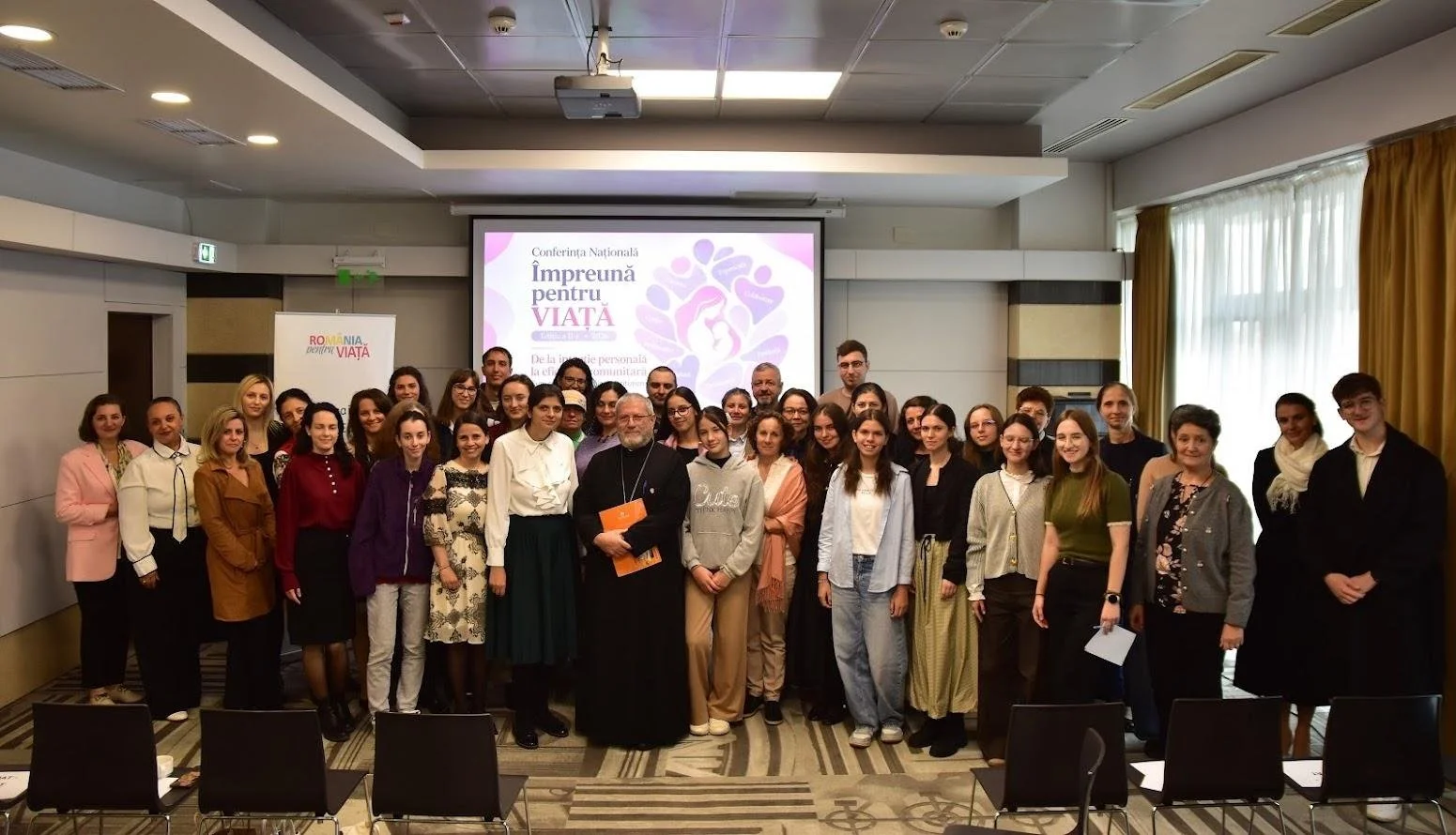
Photo Credits: Romania for Life Association (Asociația România pentru viață)
There’s a side of the pro-life movement that rarely gets any visibility at the UN – it’s made up of individuals, organizations, and even cross-country networks choosing to offer their time, financial resources, and knowledge to support women facing unplanned pregnancies, also known as crisis pregnancies.
On this very topic, we joined and spoke at a national conference held in Bucharest, Romania, entitled From Individual Help to Community Mobilization: How to Build Institutional Support and organized by Romania for Life Association (Asociația România pentru viață.)
The conference was dedicated to equipping, supporting, and connecting individuals and organizations working to help mothers in need, including in their roles as therapists, OB-GYN obstetricians, or pregnancy resource center presidents.
In an exchange with IYc, Alexandra Nadane, the host of the conference, mentioned,
“In Romania, I meet people who want to support women facing a pregnancy crisis, but who, in turn, need training, resources, and partners to build sustainable services. I initiated this conference out of the conviction that we have much to learn from one another—even across borders—so that any woman who asks for help can find people prepared to stand by her.”
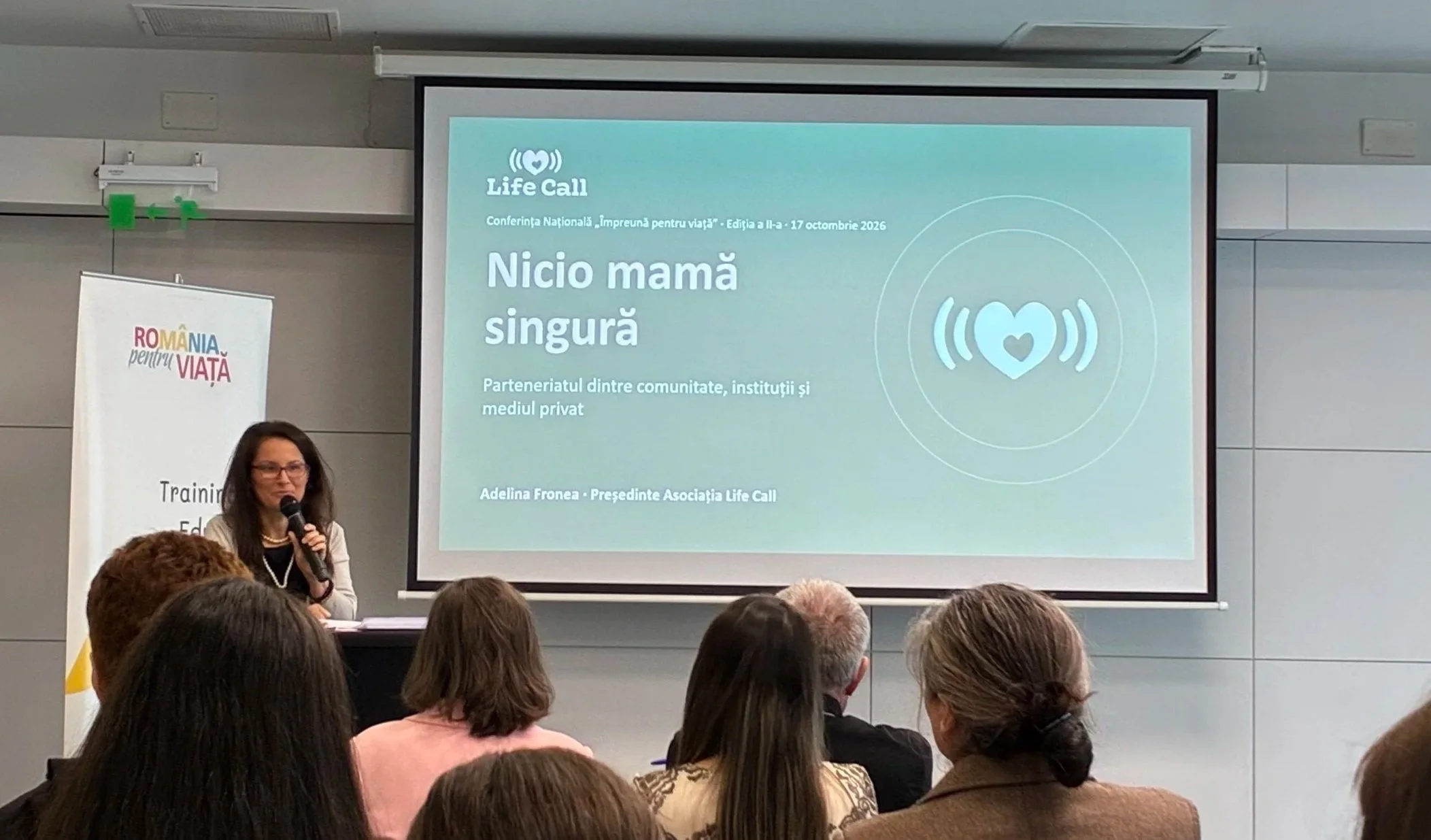
Photo: Presentation of Adelina Fronea
During her talk, Adelina Fronea, President of LifeCall, an association offering emotional, material, and financial help to mothers in need up until their child reaches the age of two, discussed the complex web of needs that usually accompany crisis pregnancies and suggested ways to respond.
Ms. Fronea linked the inability to pay one’s rent with several other dire needs, including the need for psychological therapy, for judicial support, medical investigation, gaining of civic rights, and the need to repair family relations.
She emphasized the importance of perseverance, of not giving up on the person in need, even when the respective mother, due to mental distress, may make collaboration difficult at times.
Ms. Fronea said the slogan “no mother left alone” sounds beautiful, but that concrete help for tough situations requires thoroughly thought-out solutions and the involvement of several actors, including NGOs, institutions, the community and companies. In this context, she pleaded for the following ethos: “A mother, a child. O community that answers.”
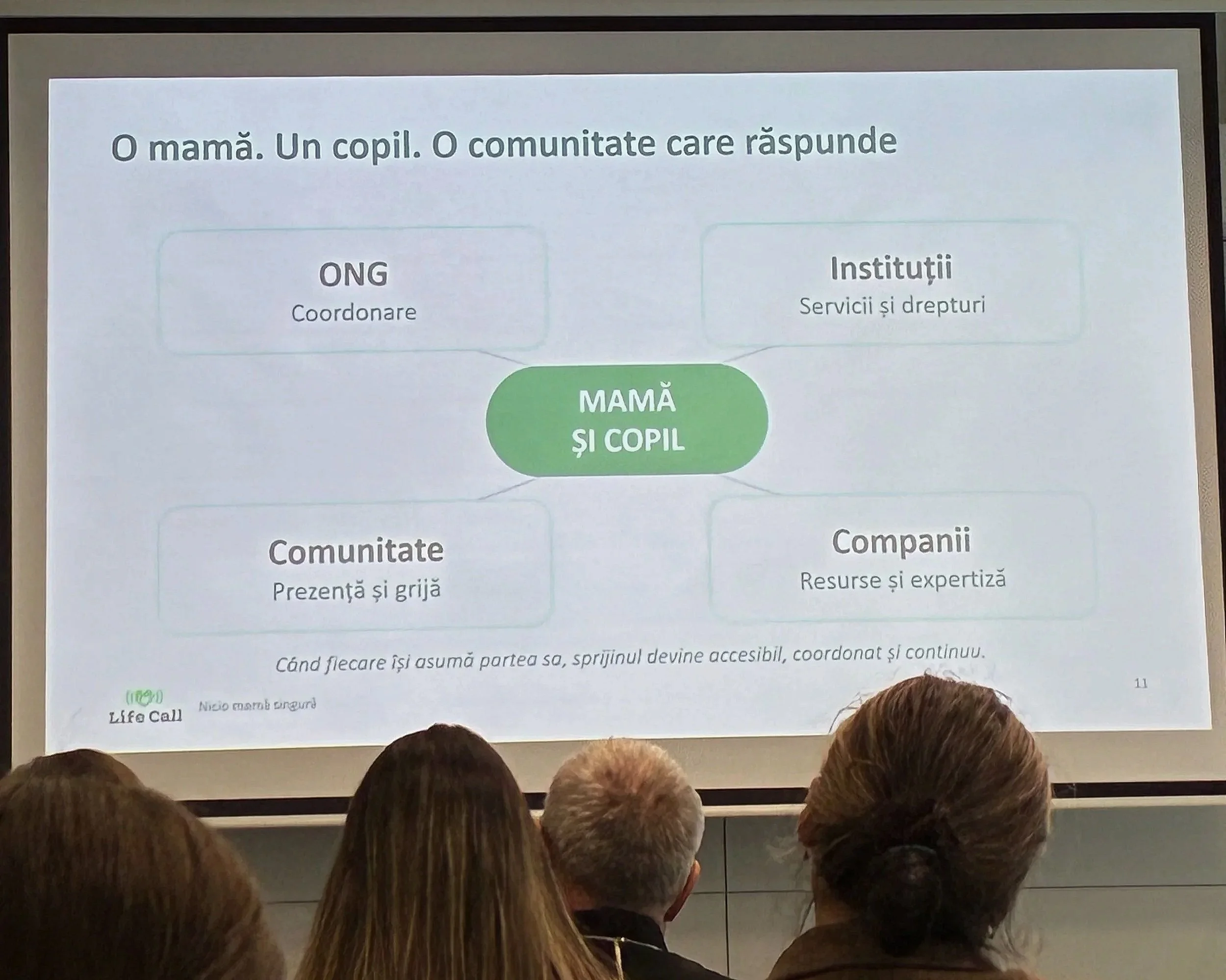
Photo: Slide from Ms. Fronea’s presentation featuring the mother and the child (mamă și copil) in the center with and a series of arrows pointing to “NGO” (ONG), “Institutions” (Insitutii), “Community” (Comunitate), and “Companies” (Companii).
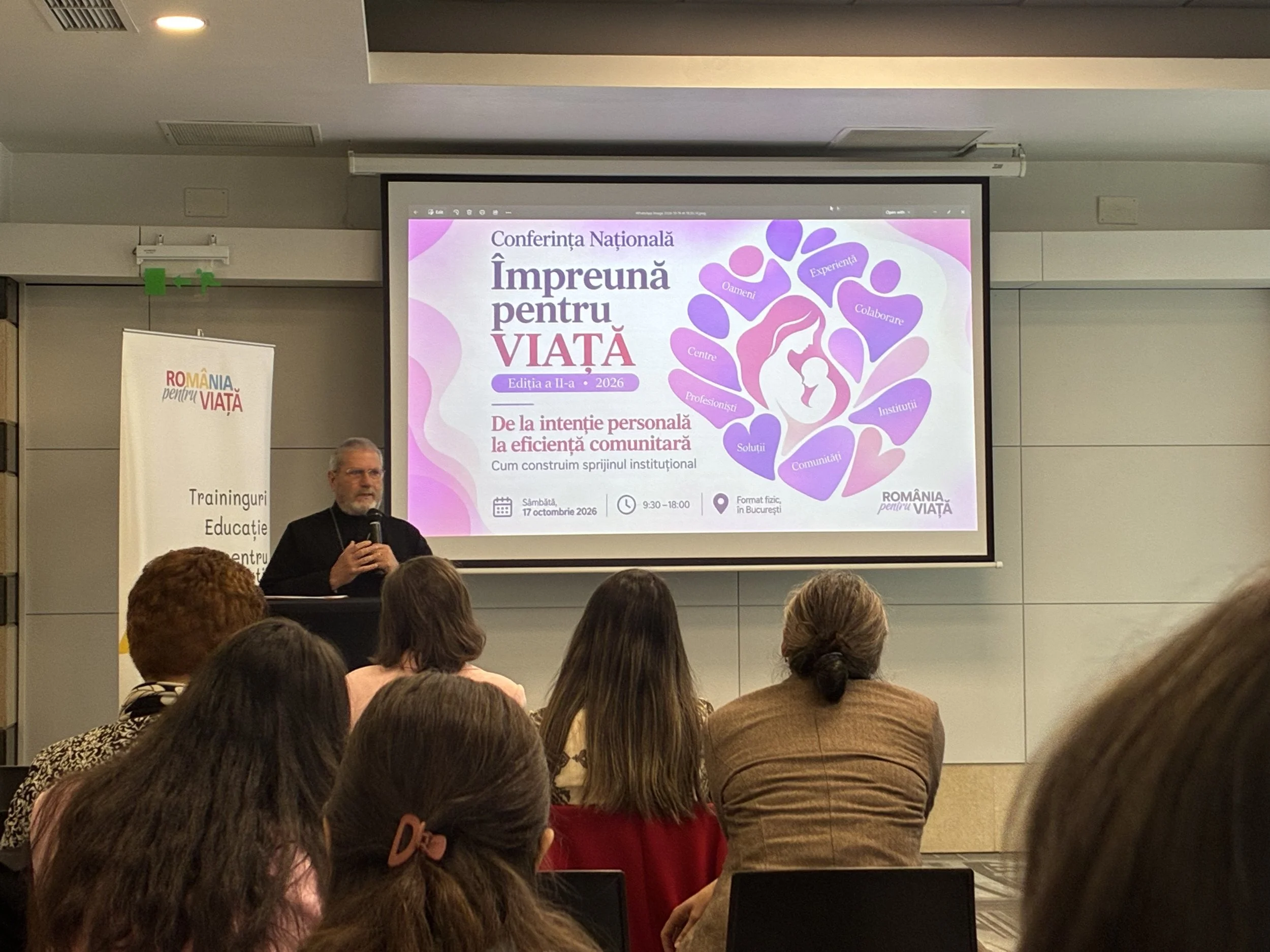
Photo: Presentation of Fr. Radu Brînză
Fr. Radu Brînză, the coordinator of ProVita Iasi, spoke about the importance of patience when working with mothers in need, “just as in agriculture there is a time to plan and a time to harvest.” Fr. Brînză suggested that we resist the tendency to approach challenges from afar and that we start paying proper attention to the concrete, the needs from people right in front of us.
“We are not called to solve the world’s problems. We are called to offer what we can,” Fr. Brînză continued.
ProVita is another example of a pro-life organization that offers tangible help to mothers in need, through psychological, financial, medical, and spiritual support, including support groups for mothers who have experienced pregnancy loss and a post-abortion therapy program.
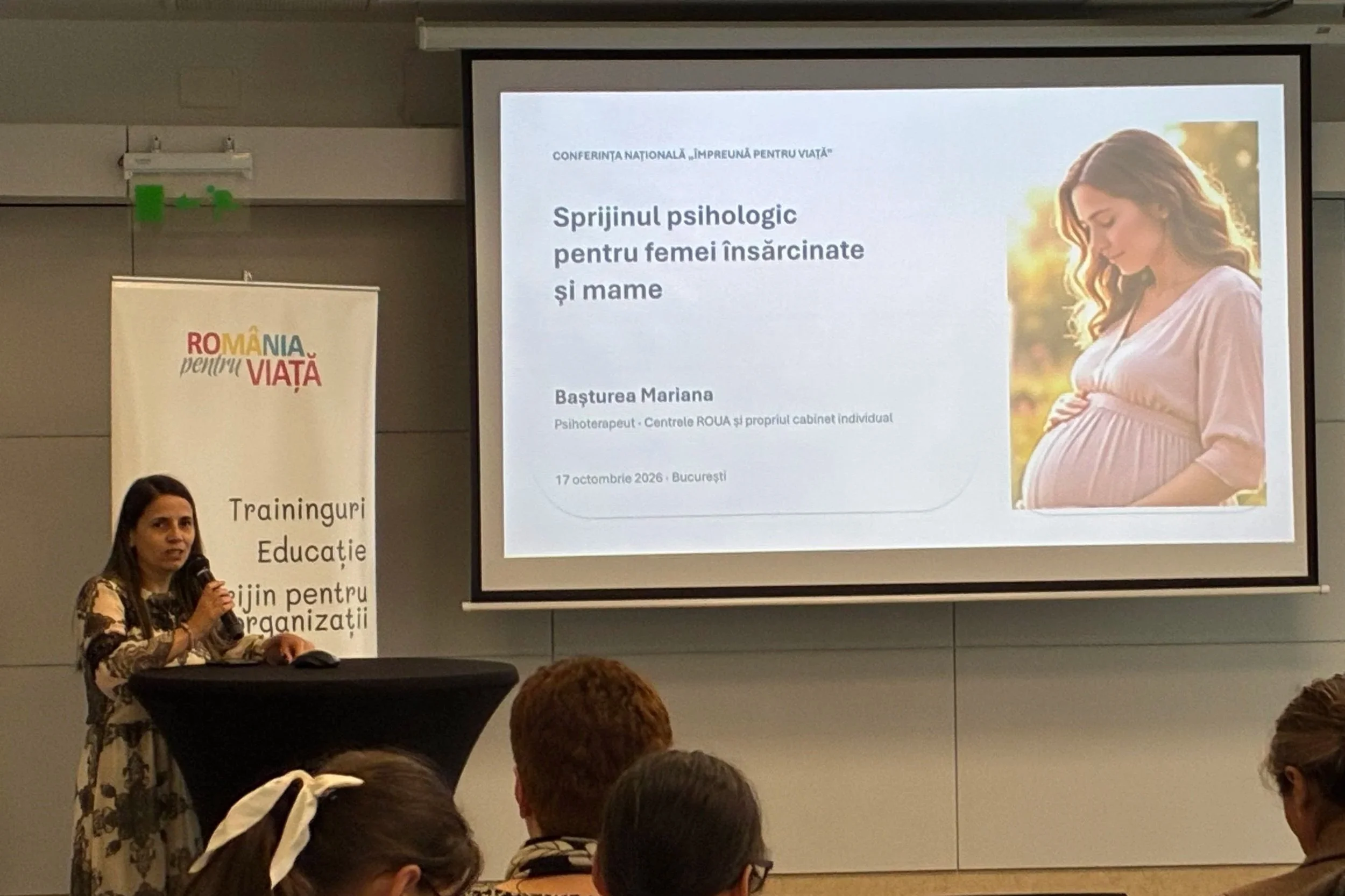
Photo: Presentation of Mariana Basturea
Mariana Basturea, Psychotherapist at Roua Centers (Centrele Roua), spoke about her experience offering psychological support to mothers facing crisis pregnancies and identified several recurring needs, including that of connection (“to be seen, heard, accepted and valued”), of competence (“to know the resources she has, to learn concrete steps and to ask for help when needed”), and of autonomy (“to express her needs and make informed decisions, taking responsibility for consequences”.)
“Support means authentic presence, rest, and shared responsibilities,” Ms. Basturea continued. She also mentioned that, whenever desired by the mother, faith becomes a very important resource for support.
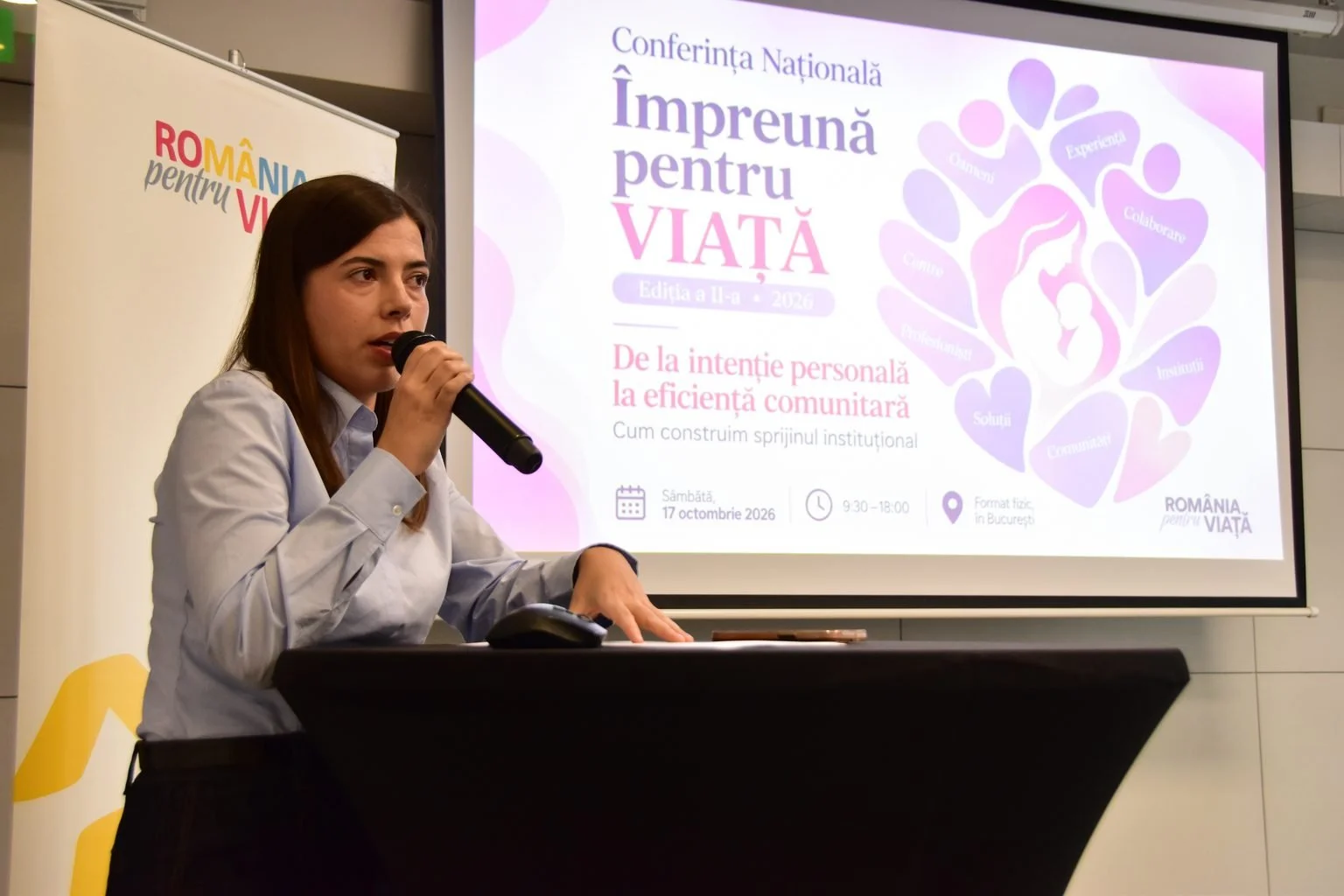
Photo: Presentation Dr. Eliza Maria Colțea; Credits: Asociația România pentru viață
Dr. Eliza Maria Colțea, OB-GYN doctor, spoke about her experience offering care for mothers whose unborn babies are diagnosed with severe health complications. Mr. Coltea discussed the importance of compassionate language when referring to the unborn baby, who deserves to be treated with dignity no matter the health complication. Moreover, Mr. Coltea explained that referring to such babies as mere mere diagnostics, or labeling them as “lethal,” “incompatible with life,” and “a burden,” only exacerbates the pain of the expectant parents.
Dr. Colțea went over the different components of holistic perinatal palliative care when the baby in the womb is diagnosed with a life-threatening disease, and emphasized that this is a type of support that “if it cannot heal” the disease, it tries its best to “offer care.”
Dr. Colțea said such care, as opposed to encouragement to undergo abortion, translates into offering the mother
“time, a relationship, one trauma instead of two [ending the life of the baby would become a second trauma], personal development and strength through suffering, better chances for a surviving marriage, memories, and options related to preferences during pregnancy, at the time of birth, and the end of the life of the child.”
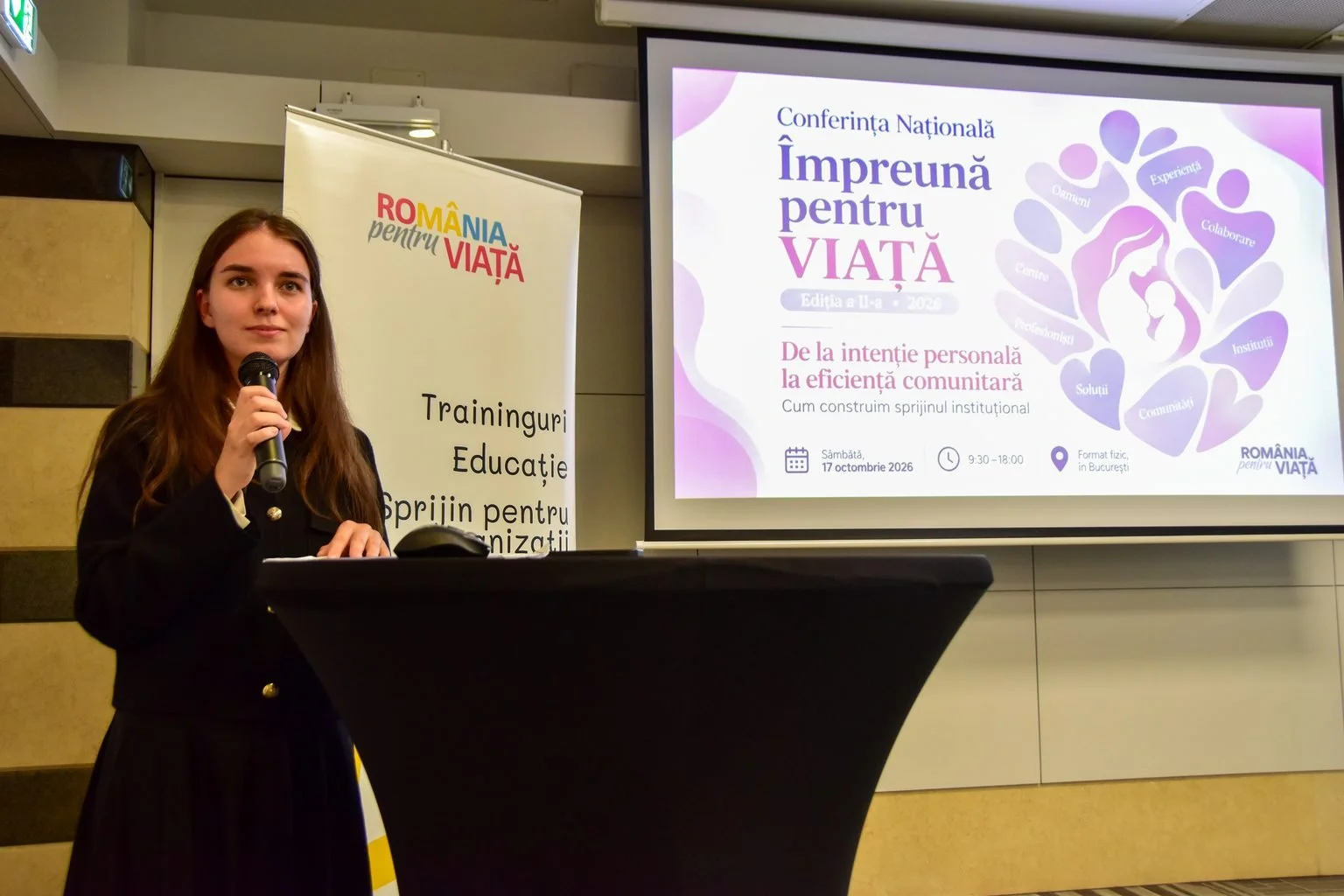
Photo: Presentation of IYc Co-Driector Iulia Cazan
Iulia Cazan, IYc Co-Director, joined the conference and spoke about the link between pro-life advocacy at the UN and local realities, as well as the reason why we don’t hear much about the term “crisis pregnancy" in the UN space, including during key commissions and events surrounding women’s empowerment. Iulia mentioned the reason is at least twofold.
Iulia said pro-life groups at the UN have to constantly defend their very existence in that space and, by extension, the existence of the pro-life worldview more broadly. She said due to ideological gatekeeping of most agencies and programs working on women’s rights, there is little room for actual impact through pro-life projects, including by crisis pregnancy centers, as they are often labeled as “anti-rights” due to their pro-life convictions.
Iulia also linked UN programs’ lack of attention to women in crisis pregnancies and even mothers in general, to a worldview that refuses “to associate women with the idea of ‘motherhood,’ considering it to be a retrograde and imposed aspiration” and rejects intrinsic dignity of the baby in the womb. She mentioned the findings from a 2026 report authored by UN Special Rapporteur Reem Aslalem as echoing the unsettling consequences of such systematic marginalization of mothers in current policies.
An OB-GYN’s Perspective on Sanctity of Life
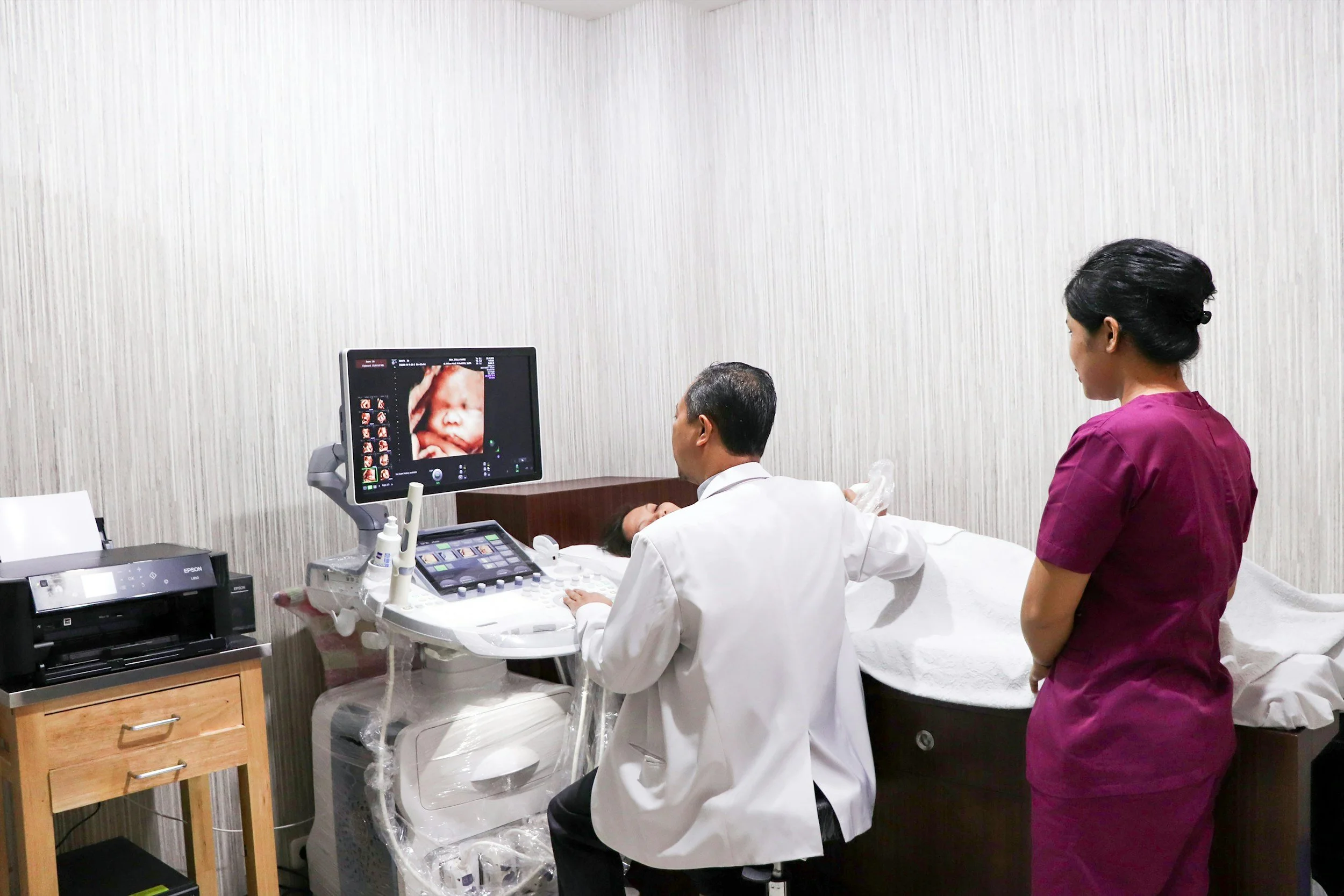
Many doctors around the world save lives every day, often without recognition. In the pro-life and pro-family movement, though, few physicians are willing to speak publicly. Some hold firm convictions but hesitate to act on them in their work environments. That makes the voice of Dr. William Lile, known to many as the Pro-Life Doc, especially valuable. He is a board-certified obstetrician and gynecologist who has spent many years defending unborn life through medicine, science, and public education.
In a conversation with IYc, Dr. Lile spoke about the abortion pill. Although it is often presented as a simple and safe option, Dr. Lile explained he has seen the serious harm it can cause, especially when offered without medical oversight, including hemorrhaging, infections, emergency surgeries, and ectopic pregnancies that go undetected because no ultrasound was done. “Women are not only being harmed or having to have emergency surgery,” he said, “women are dying as well. That is not healthcare.”
Dr. Lile cited a study showing that about one in ten women “experience sepsis, infection, hemorrhaging, or another serious adverse event within 45 days following a mifepristone abortion.”
Dr. Lile told us about the great advances in medicine and that doctors now operate on babies before birth, treat their conditions, and care for them as patients in their own right. “When I have a pregnant patient, I actually have two patients,” he explained and framed defending the unborn as a physician’s duty to serve everyone in his care.
Raised with a biblical worldview, Dr. Lile believes each person has a limited time to defend others, even when it brings criticism. “Horrible things happen because good people don’t stand up to prevent them,” he said. In the end, he sees the defense of life as a spiritual battle, rooted in the truth that every human being is created in the image of God.
His testimony is a reminder that science, faith, and conscience point in the same direction. Every patient deserves protection, no matter how small. To learn more about Dr. Lile’s ministry you can visit his website: prolifedoc.org
NEWS 🗞
Vatican Criticizes UN on Abortion [C-Fam]
The UN & Abortion for Kids [C-Fam]
WHO to Censor Pro-Lifers [C-Fam]
RESOURCES 💡
“From classroom debates to full time advocacy, Mockler shares the stories that change hearts” IYc member Catherine Mockler shares a candid and inspiring story about her journey as a pro-life advocate, including the challenges she faced and how she managed to overcome them. Read it here.
In celebration for International Human Rights Day on December 10th, Romania for Life Association (Asociația România Pentru Viață) launched an international contest for pro-life artwork under the theme, “The Right to Life: A Human Right for Every Human Being.” Submissions can include visual design, short film, animation, and writing. Learn more here.